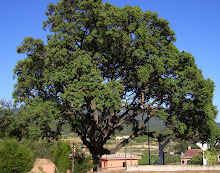
September 29 is St. Michael's Day and around this date, summer returns here with very sunny and warm afternoons.
This year the two big Spanish trade unions planned a general strike for this day. Around the countryside there were very few people participating; most of the farmers are self-employed and a lot of other workers had to guarantee minimum services as fire-fighters or nurses. It was more or less a public sector and big industry strike; and as train and bus drivers went on strike and others blockaded important roads other people had problems to get to their jobs.
The trade union's perspective is typical of European trade unions: they look to the interests of their members and do not care about the unemployed or the economy in general; the Spanish unemployment rate is around 20%, and for workers under 35 it is around 42%! Dominique Strauss-Kahn recently talked about the "lost generation" in this context. Around 40% of people with a university degree who have a job work in areas they are overqualified for. On the World Economic Forum's competitiveness index Spain has fallen to the same level as Costa Rica, I think, around position 40, while countries such as Sweden, Finland, Britain, Germany have climbed positions. Yesterday Moody's lowered Spain's debt rating.
Trade unions should become more realistic and wait if the recently introduced labor reform leads to more employment before opposing every change. And the goverment should continue with their reform program and raise the retirement age to 67; Spain has one of the oldest populations in Europe and due to its benign climate and good health system life expectation is continually growing.
Where the government is wrong is in cutting education funds: Spanish students are only mediocre in the PISA studies and its universities do not figure on the lists of the world's best. And there is a brain drain of graduates who do not find adequate employment to the north of Europe and America.
Friday, October 1, 2010

Grape harvest 2010: Carinyena
 Carinyena is the grape variety we harvest last. This year its quality has been good to very good. On the family architect’s field we harvested in a muggy afternoon 30 boxes of premium quality grapes, and on a breezy Saturday a tractor load of good grapes. The vines are old and not supported by guiding lines, i.e. they grow close to the ground and it is hard on your back harvesting the grapes. On the field we went to they use a method called “sexual confusion” to prevent a pest from mating and multiplying; the system comes from Japan and works with smells, I think.
 As to the harvesters we were the typical family team: the 82 year old officially retired wine grower, uncle of the 61 year old public sector worker and active wine grower, his 56 year old wife (officially in charge of all the family’s agricultural activities as she once received subsidies as a young farmer), the already mentioned 47 year old family architect on visit from the capital (owner of the field) and the active wine growers’ 38 year old immigrant son-in-law who irregularly works in editing and translation.
For breakfast there was salted herring roasted on-site for those who like it, the uncle cooked some tomatoes on the fire, too; then there was bread with ham and cheese, nuts and cookies, water and wine.
In general, 2010 has been a very good year as to the grapes’ quality due to a cool and rainy winter and a very dry summer.
(Written on Sept. 27 but not posted earlier due to problems with the internet connection.)
Tuesday, September 21, 2010
The grape harvest again
Two weeks ago the grape harvest finally started in our village. The time depends on the grapes' maturity and varies from region to region and village to village and probably according to the winemakers' preferences, too. Before and during harvest time, the wine growers watch the weather forecast more closely than they normally do as a lot of their future income depends on the state of the grapes on harvesting day.
The local cooperative determines which growing zones and grape varieties get preference and how the harvest proceeds. During one or two days a rabbi comes from Barcelona to supervise personally the delivery of the grapes that are used in the production of kosher wine - a great idea to draw a lot of attention to the cooperative and its other wines that sell in more than 40 countries.
Though in other places the harvest is widely mechanized, here the grapes are harvested manually: a labor-intensive and back-breaking operation. One heads out before sunrise, often accompanied by relatives from the city who return for a few days to reconnect with their roots and lend a helping hand. The best part of the workday is the breakfast hour around or shortly after the full sunrise; the traditional meal consists of herring roasted over an open fire accompanied by bread and wine.
As one works side by side with the others there is a lot of time for the exchange of family news and village developments. After all the news have been shared it's time for the old stories that are retold for the benefit of the younger generations and the newcomers: stories involving villagers dead or alive and crimes or scandals.
The afternoon is normally quieter as the work seems harder with tiredness and higher temperatures. One goes to bed early as the body demands rest.
These events are repeated every year. During the first week one still enjoys it. Afterwards it becomes a little tiring, especially if the mosquitoes and flies do not move away from one's head on a muggy day and the grapes begin to rot due to late harvesting or rain showers not untypical for this time of the year.
The local cooperative determines which growing zones and grape varieties get preference and how the harvest proceeds. During one or two days a rabbi comes from Barcelona to supervise personally the delivery of the grapes that are used in the production of kosher wine - a great idea to draw a lot of attention to the cooperative and its other wines that sell in more than 40 countries.
Though in other places the harvest is widely mechanized, here the grapes are harvested manually: a labor-intensive and back-breaking operation. One heads out before sunrise, often accompanied by relatives from the city who return for a few days to reconnect with their roots and lend a helping hand. The best part of the workday is the breakfast hour around or shortly after the full sunrise; the traditional meal consists of herring roasted over an open fire accompanied by bread and wine.
As one works side by side with the others there is a lot of time for the exchange of family news and village developments. After all the news have been shared it's time for the old stories that are retold for the benefit of the younger generations and the newcomers: stories involving villagers dead or alive and crimes or scandals.
The afternoon is normally quieter as the work seems harder with tiredness and higher temperatures. One goes to bed early as the body demands rest.
These events are repeated every year. During the first week one still enjoys it. Afterwards it becomes a little tiring, especially if the mosquitoes and flies do not move away from one's head on a muggy day and the grapes begin to rot due to late harvesting or rain showers not untypical for this time of the year.
Friday, August 6, 2010
How to gain publicity for your "Oktoberfest"
These days Avilés, a town of 84.000 inhabitants in Asturias, is frequently on the news because it's socialist city councillor for women's affairs wants the organizers of a beer fest to change their poster announcing the event as she deems it sexist. The poster is the one acompanying this post

and the question is debated widely in the Spanish blogosphere. Helpfully a blogger already has put together a collection of American posters inviting to similar events.
The link is here.
If the authorities in Munich thought as the councillor in Avilés does they would have to impose dress codes on the waitresses there...
All of this might be part of what Javier Marías sees as a growing trend in Spanish society of prohibiting everything that you do not like. There certainly is this trend but a lot of things they want to prohibit I would prohibit, too, e.g. smoking in restaurants, bars and other public places or bull fighting in Catalonia (I would prohibit it in all of Spain, too).
and the question is debated widely in the Spanish blogosphere. Helpfully a blogger already has put together a collection of American posters inviting to similar events.
The link is here.
If the authorities in Munich thought as the councillor in Avilés does they would have to impose dress codes on the waitresses there...
All of this might be part of what Javier Marías sees as a growing trend in Spanish society of prohibiting everything that you do not like. There certainly is this trend but a lot of things they want to prohibit I would prohibit, too, e.g. smoking in restaurants, bars and other public places or bull fighting in Catalonia (I would prohibit it in all of Spain, too).
Saturday, July 24, 2010
Animals and Climate Change
After reading the current number of Fluter, a German youth magazine on political topics, I am seriously thinking about becoming a vegetarian, or at least reducing my intake of meat and dairy products.
Up to now I was not aware of the enormous amount of CO2 and other climate killers such as methane produced by cows and other domestic animals. In one of the articles it says that the problem of the future will not be the nine billion people on earth but the still larger number of cows, pigs, etc. to feed them as more and more people switch to meat-eating as they become richter... I never especially liked dogs; now there is another reason not to have one as a German shepherd, for example, during a year produces about half the amount of carbondioxide of a European human being.
I am not sure this entry is good English but I am getting out of practice with Catalan provincial journalism...
Up to now I was not aware of the enormous amount of CO2 and other climate killers such as methane produced by cows and other domestic animals. In one of the articles it says that the problem of the future will not be the nine billion people on earth but the still larger number of cows, pigs, etc. to feed them as more and more people switch to meat-eating as they become richter... I never especially liked dogs; now there is another reason not to have one as a German shepherd, for example, during a year produces about half the amount of carbondioxide of a European human being.
I am not sure this entry is good English but I am getting out of practice with Catalan provincial journalism...
Saturday, June 19, 2010
Burqa, no; T-Shirt, yes, please!
Strange times in Catalunya. More and more city and village administrations are introducing local ordinances that prohibit the wearing of a burqa or other face-covering Islam-inspired dresses inside public buildings. As if the streets were full of burqa-wearing women ready to storm city hall. The craze is such that even villages where there are no immigrants at all are thinking about introducing such a measure preventively in case a burqa-wearing immigrant wanted to move there. And parties on the political right are insisting that the words "burqa" or "niqab" are included in these ordinances; the prohibition of entering a public building with your face covered does not do it for them - pure knee-jerk populism in an election year (regional elections to the Catalan parliament in November 2010). Surveys say that a majority of the population would prohibit the burqa in public places, i.e. on the streets in general, but local administrations can only rule on public buildings.
Meanwhile the city of Barcelona has got a different problem at the same time: apparently a lot of tourists like to wander around Las Ramblas in the heart of the old town or use the metro with nothing on but a bathing suit or bikini; often not a nice view, and apart from aesthetics a potential public health problem. Therefore, the city will fine these "nudist" tourists, but first wants to raise awareness to the problem with an information campaign ("dress well") and stickers like the one pictured down here. We are living in strange times.

Meanwhile the city of Barcelona has got a different problem at the same time: apparently a lot of tourists like to wander around Las Ramblas in the heart of the old town or use the metro with nothing on but a bathing suit or bikini; often not a nice view, and apart from aesthetics a potential public health problem. Therefore, the city will fine these "nudist" tourists, but first wants to raise awareness to the problem with an information campaign ("dress well") and stickers like the one pictured down here. We are living in strange times.

Tuesday, June 1, 2010
Not really news

This is a short version of a news story I wanted to write but was not allowed to as the chief editor thought the topic was already everywhere else and not really of interest to our readers, and he might have been right ;-)
As I browse the news about the ”iPad” I see that today’s headline is that the gadget has already been sold more than 2 million times since it came on the market two months ago, or 60 days to be more precise. In Europe, it’s launch came last Friday, May 28th, and at least in Madrid stocks sold out within hours. This is quite amazing, as the gadnet does not come cheap: the iPad’s most basic version costs 479,- € in Spain (499,- € in France, Italy, Germany) and 499,- USD in the States, the most complete one (with 64GB memory and 3G access) 779,- € in Spain (...) and 799,- USD.
The iPad is a tablet PC, something between a smartphone and a laptop computer. It’s LED screen has a size of 9,7 inches and you can use it by touching on the screen. The simple version can connect with the internet via a wifi red, the more advanced version can use mobile internet via a 3G red – but you need a separate service contract (that will cost you around 35 € per month if you opt for the flat rate option in Spain). The typical user of the iPad will be more of a consumer than a creator as the machine incorporates the typical Apple programs for contents consumption rather than creation - it's not a MacBook (from 979,- € in Spain). With the iPad the company also launched its own digital bookstore and wants people to read the book on the pad – though it does not offer the digital ink technology typical of other e-readers’ screens. The user can also use e-mail and administrate music, videos and fotos but the iPad does not incorporate a camera. Neither are there USB slots. It also does not support contents made with flash technology. And it can do only one thing at a time, i.e. there is no multi-tasking. These are the main points of criticism alongside the absolute control that Apple has got about what you can and what you cannot do with your machine and that it is a little difficult to type on a touchscreen. On the positive side are the iPad’s slick design, its speed in executing tasks, its low weight and the long battery life, up to 10 hours without recharging. And you can buy some accessories like a dock with a USB slot and a physical keyboard, if you like to. There are already competitors in sight: the iPed (I think, Chinese ;-)), and more seriously NVIDIA’s Tegra2.
What I personally find most suspicious is the exclusivity as to the applications one can use with it. If I had to buy a device like that right now, I would go for a far cheaper netbook and watch as Apple develops future generations of the iPad like it does of the iPhone all the time.
Subscribe to:
Posts (Atom)